Saturday, October 27

Amazing GIS

GIS software is useful for any industry, allowing police, public health workers, journalists, weather forecasters, educators, researchers and planners of all types to pinpoint details on a map and show areas of need. The software can take thousands, millions of data points, rendering them instantly understandable with one glance.

The US Army Geospatial Center, US Army Corps of Engineers,  maps out terrorist incidents in Afghanistan. "The map examines civilian casualties due to acts of terrorism in Afghanistan from 2004 to 2009." Unfortunately, we noticed that the beautiful map has since been removed, but its creator relied on the style of maps from the 1930s and 1940s, found in the US Library of Congress, depicting a contemporary conflict with the most modern of technology.

The uses of ArcGIS are many. For example: "The World Bank sees GIS as vital for addressing poverty and climate change," notes the website for Esri, the company that makes ArcGIS.

"The World Bank Institute's Innovation Team has geocoded and mapped more than 30,000 geographic locations for more than 2,500 bank-financed projects worldwide under its Mapping for Results initiative," writes Rachel Kyte, vice president for sustainable development at the World Bank. "All new World Bank projects are now georeferenced to ensure that development planners can track and deliver resources more efficiently and effectively and avoid work duplication."

GIS maps come in all colors and styles.  And just as there is a Peace Corps, there is also a GISCorps. GIS changes how we see our world, and of course it had to make an appearance in Fear of Beauty.

Partial GIS map, showing coal resources in north Afghanistan, courtesy of the US Geological Survey.




Thursday, October 25

Goodreads

Sign up to receive a free review copy of Fear of Beauty through the Goodreads Giveaway.

The contest ends December 1.


Power

During the US presidential debate, in addressing questions on the Middle East, President Barack Obama mentioned three times that religious minorities must be protected. Understanding the nuances in the region is essential. Sometimes minorities abuse power over majority populations, as is the case in Syria. Sometimes majorities abuse power over minority populations.

"Understanding the sects and their tensions is crucial in crafting any foreign policy for the region," I wrote for The Washington Post's On Faith blog. 

Tolerance of others' beliefs,  provides security. Extending respect for those not in power provides security. As James Madison noted, "In Republics, the great danger is, that the majority may not sufficiently respect the rights of the minority." He also warned that tyranny and oppression arrive in the guise of fighting a foreign enemy. Good advice for any country.

The power that comes with example, culture, trade, education, diplomacy and more, can influence more than military power. Sadly, one of the great resources of the US State Department, its Background Notes and Country Profiles, are no more. What a loss ...

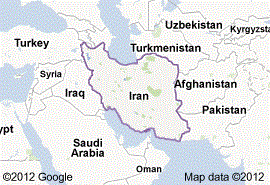
Examining the State Department's notes on percentages of Shia and Sunnis in the region - 35 percent Sunni and 62 percent Shia in Iraq; 9 percent Sunni and 89 percent Shia in Iran - along with a glance at a map, makes one wonder what the Bush administration was thinking when it decided to invade Iraq in March 2003. 

Map courtesy of Google.